İZMİR NEW MUSIC DAYS VII, 22-27 Oct. 2026
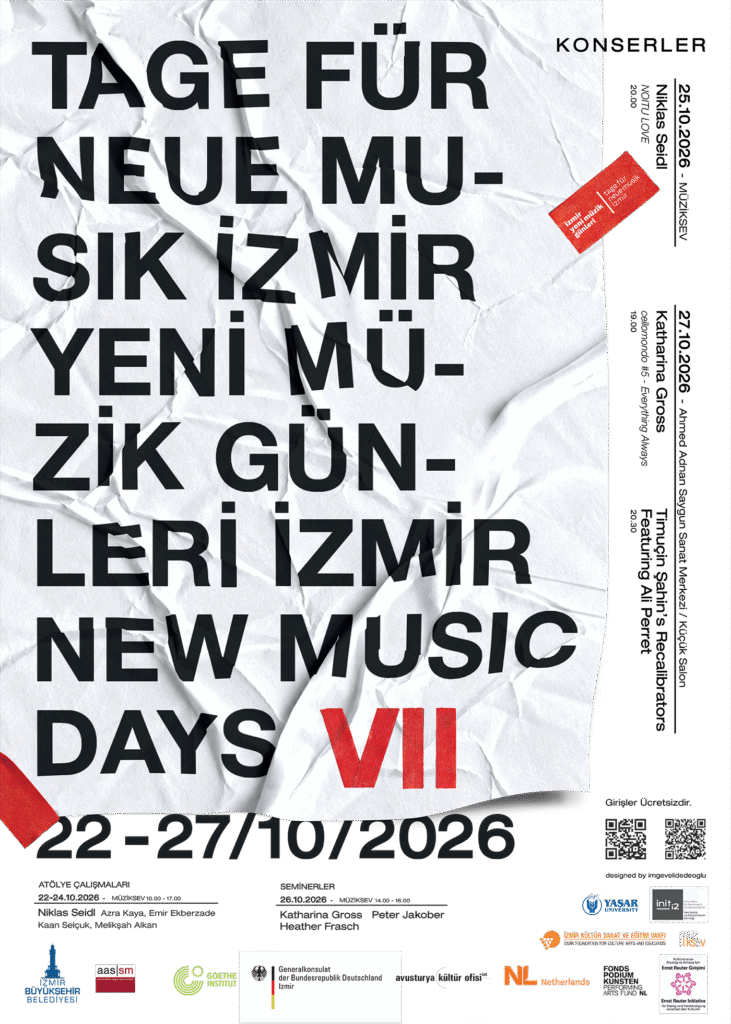
Taking place from 22 to 27 October 2026, the seventh edition of İzmir New Music Days brings together diverse modes of musical production and listening that expand the boundaries of music. This year’s programme encompasses a wide range of approaches, from solo cello and electronics to music theatre, from collective improvisation to audiovisual works, revealing music as an experience shaped not only through sound, but also through the body, technology, space, and collective production.
The opening concert, Niklas Seidl’s NOITU LOVE, questions the idea of human development through its title, formed by reversing the word “evolution,” while presenting a repertoire that expands the boundaries of traditional instrumental practice through the use of the body and electronics. Alongside works by Rolf Riehm, Steven Kazuo Takasugi, Niklas Seidl, Juliana Hodkinson, and Jennifer Walshe, Seidl’s programme also includes new works by Azra Kaya, Emir Ekberzade, Kaan Selçuk, and Melikşah Alkan, commissioned within İzmir New Music Days’ Next Generation Series. The concert will take place on 25 October 2026 at 8:00 p.m. at Müziksev.
On 27 October 2026, the Small Hall of Ahmed Adnan Saygun Art Center will host two consecutive concerts. At 7:00 p.m., Katharina Gross presents cellomondo #5 – Everything Always, which transforms the simultaneous perception of noise, music, speech, and machine sounds in urban soundscapes into a musical and visual space for reflection. The programme features works written for Katharina Gross over the past two years by Kunsu Shim, Peter Jakober, Janco Verduin, Katharina Gross, and Heather Frasch.
Another central axis of the festival is the fluidity between composition and improvisation. At 8:30 p.m., Recalibrators, led by Timuçin Şahin, draws on Lawrence “Butch” Morris’s practice of conduction to shape music collectively in the moment of performance. With the participation of pianist and composer Ali Perret, the ensemble’s constantly evolving sonic universe gains a new dimension.
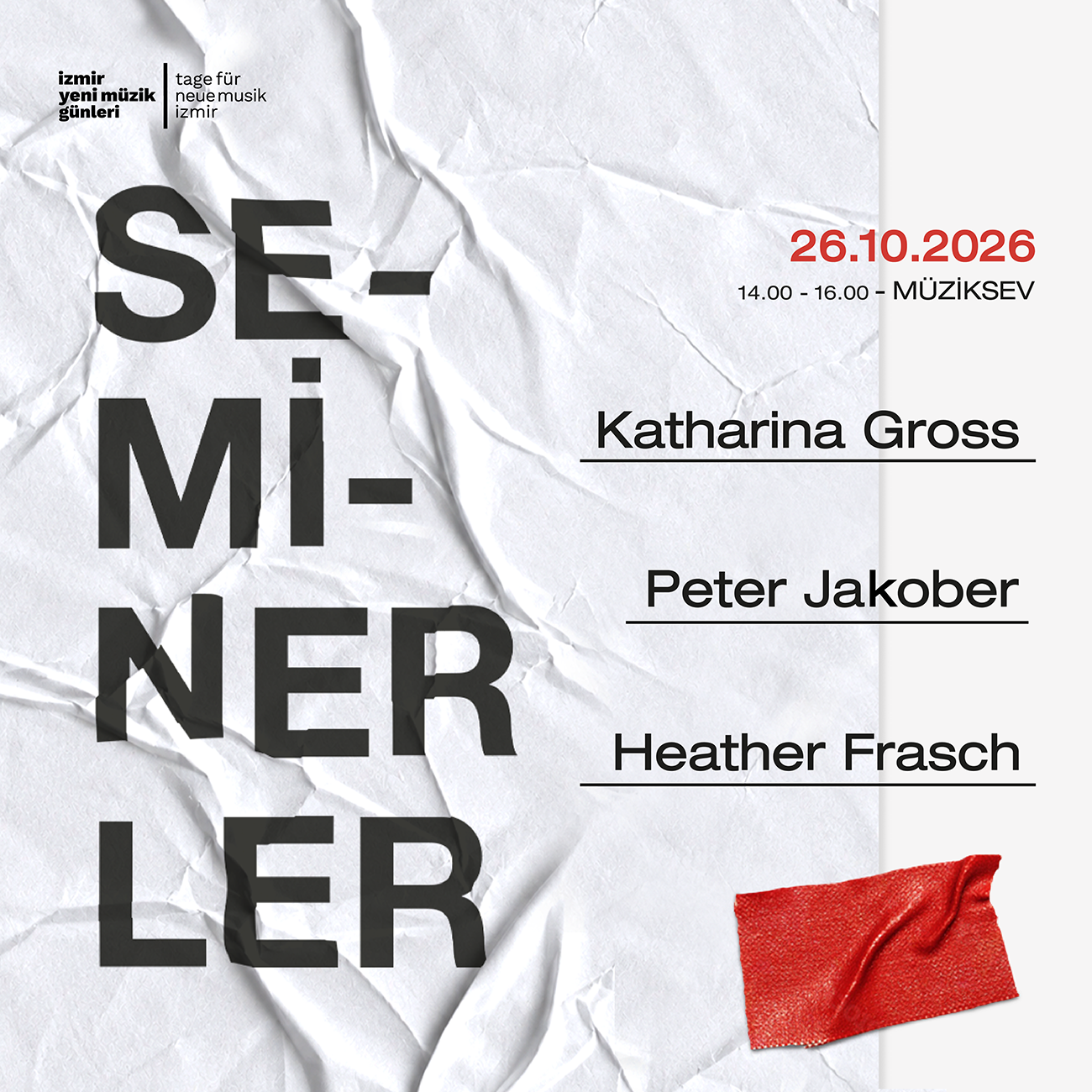
The festival will also include a workshop for young composers led by Niklas Seidl from 22 to 24 October 2026, as well as a seminar by composers Katharina Gross, Heather Frasch, and Peter Jakober on 26 October, from 2:00 to 4:00 p.m. at Müziksev.
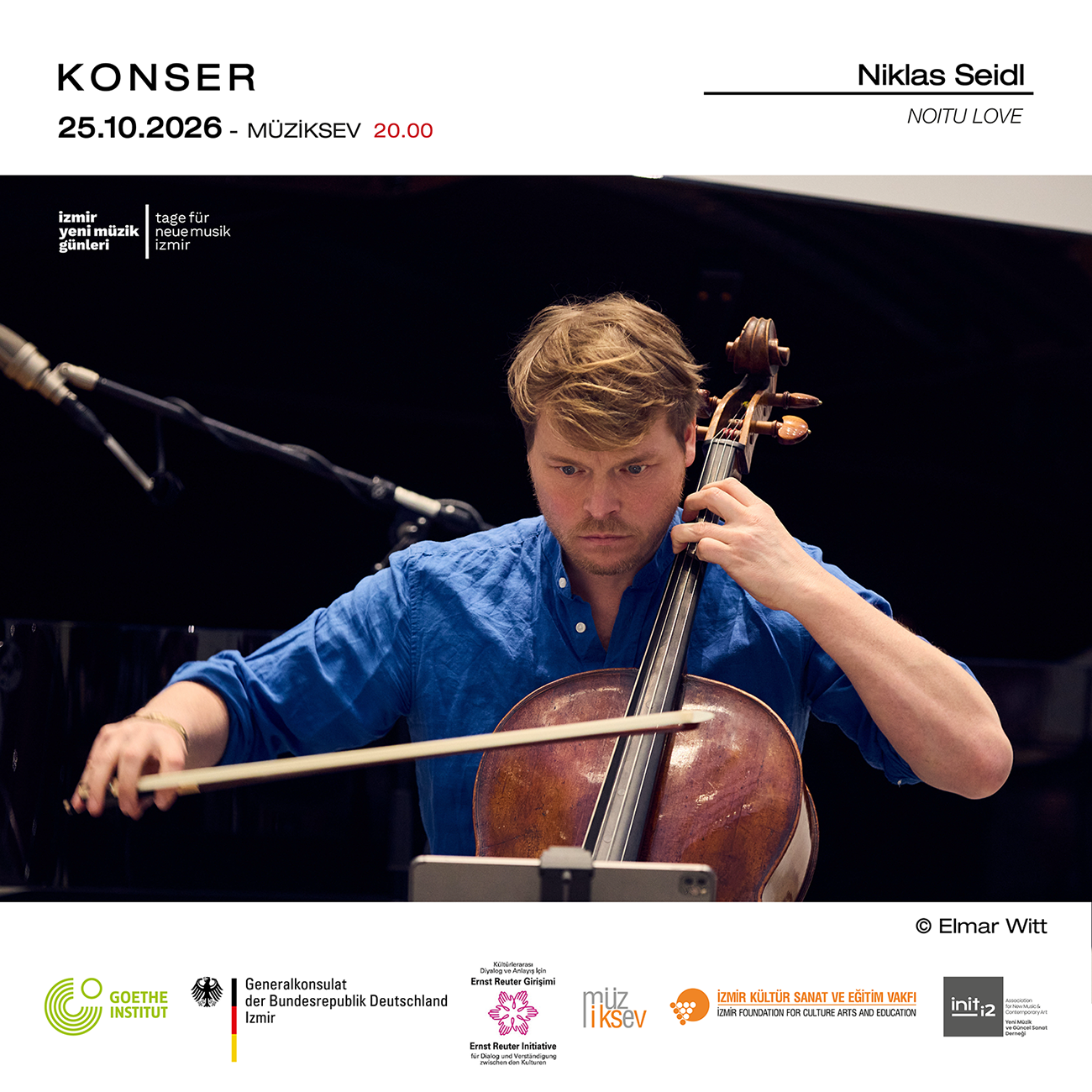
Niklas Seidl
NOITU LOVE
25.10.2026-20.00 Müziksev
The concert for a cellist/performer creatively traces the evolution of humanity’s increasing reliance on technology through music.
Beginning with an exploration of the musical instrument and moving on to the incorporation of the voice, the cello—symbolizing the tool—initially takes center stage in this evolution. Electronics are introduced as an extension and eventually take over music production entirely, with the human presence serving only as an archival reminder of what once was. However, this evolution is possible in any direction, so that in this concert, the steps are jumbled together to form a coherent concert structure.
Program
stone-improvisation 1’
-archaic humanity discovers active sound production on tools
Juliana Hodkinson, Jounce (2016) for cello 4’
-the cello as a human tool first is discovered as a rhythmic instrument
Emir Ekberzade, Conflux (2026 DP) for cello 8’
technology: an approach to the composer’s exploratory world between the past and the present.
Azra Kaya, heterotopia (2026 DP) for cello and electronics 4’
imitates the connections between how the human brain perceives time and remembers the past
Steven Kazuo Takasugi, Letters from Prison (2009) for tape 5’
-the electronics have taken over music production. the human being is only there as a trace in recordings of a lung infection
Melikşah Alkan, ÖTEYAKADAN TAKAZA Act.0 (2026 DP) miniature cello-theatre 7’
– The urge to maintain a mental connection despite physical absence finds its form through an imaginary correspondence with a late friend.
Niklas Seidl, Malte Eister (2009) for cello and cassette-deck 7’
-the musician learns to play the instrument, first by reproducing and later by breaking out of the “language course”
Kaan Selçuk, loops 1 (2026 DP) for oud and electronics 3’
alternatively for a monkey and a typewritter
Jennifer Walshe, That’s a lot of money at the top of a rocket (2024) for cello 5’
-the human voice finds its way into music alongside the cello
Rolf Riehm, Ach, Königin (2005) for cello 9’
-the human voice is devoured by intellectual instrumental music. Riehm quotes the Queen of the Night from Mozart’s Magic Flute through theoretical channels
PROGRAM NOTES- Next Generation Series-VII
Azra Kaya’s piece, heterotopia, carries personal impressions of the concepts of simultaneity and fragmentation found in Foucault’s text “Of Other Spaces.” It embodies the idea of time transforming into intersections of points and networks, rather than unfolding as a spatial flow. By juxtaposing the near and the distant, the present and the past, the work prioritizes a simultaneous experience. The cracks and fragmentations represent the conflict that everyday spaces create within the individual’s sense of self.
ÖTEYAKADAN TAKAZA Act.0, by Melikşah Alkan, is a music theater piece that focuses on the emergence of Ferit Edgü’s text, Orhan Duru: Ölmeden Önce – Öldükten Sonra. On stage, the threshold where Edgü writes the text and words have not yet fully found their form is enacted. Sound, word, and body gradually fill the void between memory and absence.
A solitary instrument forms the spine of this process. Cyclical motifs emerging from the instrument are fragmented and expanded by electronics, creating their own time. As every heard timbre seeps into syllables and blends into the formation of language; the written, the heard, and the imagined intertwine.
Act.0, rather than a narrative scene in the traditional sense, is a structure that traces the very emergence of the text through sound. It stages the act of writing not merely as the transmission of a thought, but as a process through which an absent figure takes physical form. In this specific performance, this entire process is channeled through the body of a cello.
Emir Ekberzade’s piece Conflux, As its title suggests, the sounds on the strings of the cello come together, mingle, and merge, like two sources of a single flow, like two rivers that run through glissando and later join. At times this meeting is prevented by an interval of a semitone and by intervals smaller than a semitone, especially quarter tones. Through scordatura, the piece calls for a new tuning system, asking for the 4th and 2nd strings to be lowered by a semitone. In this way it creates a new sound system of 8–6–8 semitones, with a tritone at the center and minor sixths at the edges, giving rise to a new harmonic and timbral world.
The music’s two main characters are at times entirely separate from each other and at times transform into each other. For me, this evokes the metaphor of a calm-flowing river turning into a fast-flowing one, and vice versa. The piece was written in Ankara and İzmir over about a month of intensive work in September/October 2026, for Niklas Seidl, to be premiered in Izmir.
Kaan Selçuk’s The Loops (Döngüler) series consists of works centered on a concise yet intricate singular material, realized through the improvisations of an acoustic instrument performer and a live electronics performer. Composed for Niklas Seidl, the first piece of the series takes as its primary material a pattern inspired by Safi al-Din al-Urmawi’s lute (oud) fretting scheme (dastgāh) and his 17-tone tuning system model. While each pattern could inherently continue ad infinitum, its projection is not always predictable and can generate striking contrasts. In Loops, this unpredictability stems not from the complexity of the pattern itself, but from the arbitrary or communicative dynamics between the performer manipulating the electronics and the instrumentalist. This duality questions the role of humanity’s collective consciousness in the face of the probabilistic mechanism of evolution.
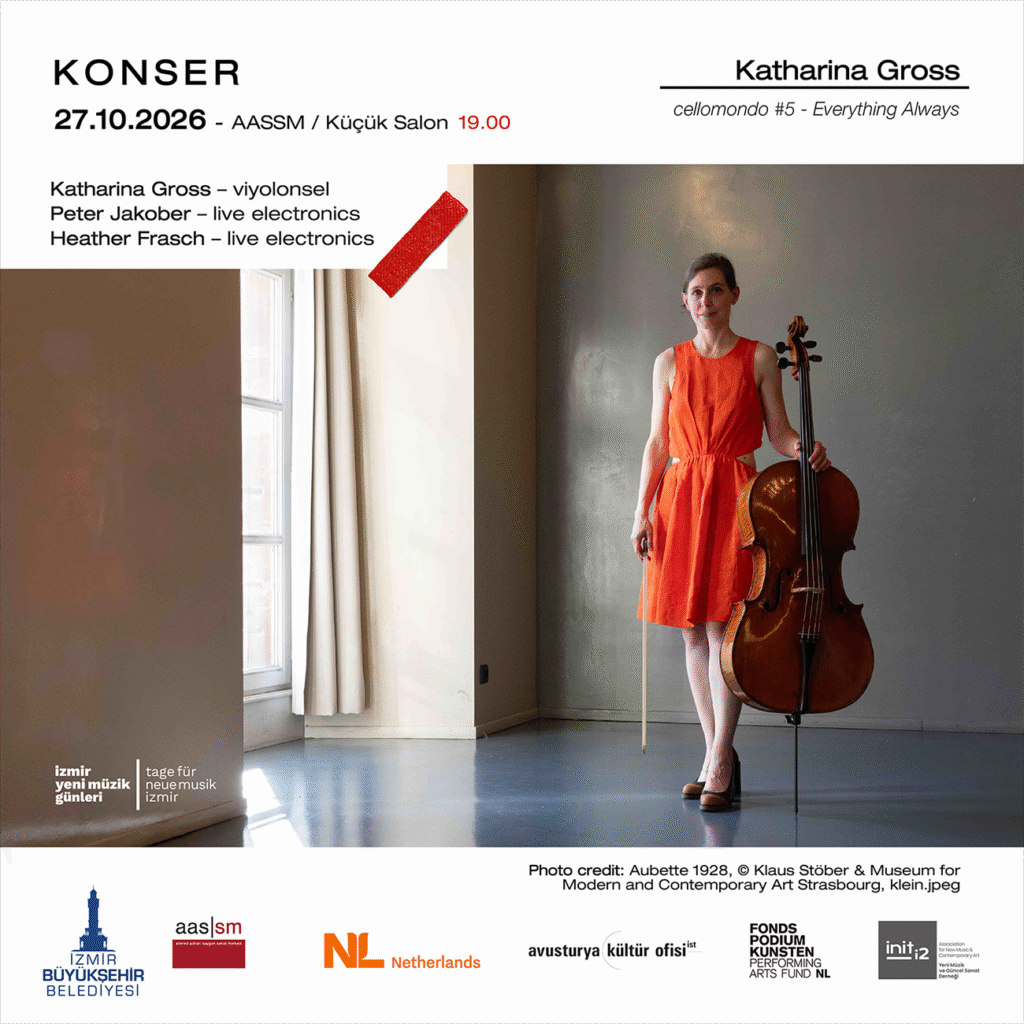
Katharina Gross
cellomondo #5 – Everything Always
27.10.2026-19.00 Ahmed Adnan Saygun Sanat Merkezi-Küçük Salon
Katharina Gross – violoncello
Peter Jakober – live electronics
Heather Frasch – live electronics
About cellomondo #5:
Katharina’s new edition of cellomondo #5 – Everything Always deals with the fascinating phenomenon of simultaneous perception. In urban soundscapes, this often means perceiving noise, music, speech and machine sounds in parallel – often unconsciously, always fragmentarily. This simultaneity creates a dissociation, but also a resonance space for reflection.
“White noise is the totality of sounds – “everything always” in its acoustic representation” says the Austrian composer Peter Ablinger. “Comparable to white light that contains all colours, white noise contains all frequencies, and – poetically speaking – all music. The idea of “Rauschen” furthermore is not empty: there is the ocean, the noise of trees in the wind. The difference between silence and “Rauschen” becomes clear when we are exposed to it, when we “listen” to it.
Program
Katharina Gross, Der Spiegel sinkt. (2025/26) for cello, electronics & visuals; inspired by the poetry bundle Delta by Norwegian writer Marte Huke
Peter Jakober, Fehl (2026) for cello and live electronics; dedicated to the fabulous Katharina Gross
Kunsu Shim (KR/DE), Wenn ein Glückliches fällt (2025) for violoncello -dedicated in friendship to Katharina Gross
Heather Frasch, Shivers (2026) for Violoncello and Live Electronics Developed in collaboration with Katharina Gross, for whom this piece was written.
Janco Verduin, Vergrößerung (2026) for amplified cello
PROGRAM NOTES
During an artist residency in Trondheim Katharina Gross creates the composition Der Spiegel sinkt., an audiovisual work which draws inspiration from the poetry collection Delta by Norwegian author Marte Huke. Huke’s poems are based on natural geographical descriptions on the one hand, while on the other hand they bring the forces of nature within and between people to life. Time is continuously organized and shaped through both social and natural processes, as Andreas Reckwitz suggests. The audiovisual composition echoes the dynamics of repetition, emergence, and disappearance that he describes—dynamics that also define Marte Huke’s Delta. A blend of cello and viola da gamba sounds, drops, rushing water, breaking waves and silence, in fusion with Huke’s poetry, form the basis for musical material. Videos show water, landscape, the human body and lecers/words/sentences… A journey through an infinite landscape that invites its audience to look, reflect, and act.
In his new work Fehl for cello and live electronics, Peter Jakober explores the tension between perfection and imperfection. As part of this residency, he examines “imperfection as quality” and its compositional and sonic realization. The cellist attempts to exactly imitate and reconstruct pre-recorded material. However, this intention “fails” due to the human aspect of live performance, as small deviations and resistances arise in the cello playing and sound. The precisely constructed and edited “click” and “tape” materials are thus contrasted with the live cellist, who produces a different, more “human” sound through minimal inaccuracies.
Heather Frasch’s piece for cello and live electronics Shivers explores notions of fragility and stillness through the creation of complex timbres, the usage of experimental notation systems, and unstable design in electronics. By customizing performance set-ups to communicate specific artistic ideas, Frasch creates sensitive sonic works that highlight fragility and emphasize micro-activity. Influenced by the dis-embodiment of acousmatic music practices, she investigates the re-embodiment of sound and the intimacy between humans and their technological objects.
Janco Verduin is a Dutch composer who combines technology, science, and art, exploring systems, perception, and complex soundscapes. His new piece Vergrößerung for amplified cello takes the listener on a journey inward, gradually moving from familiar sounds into an unfamiliar microcosm.
By compressing the cello’s dynamic range and amplifying it, subtle sounds normally lost in concert hall acoustics become the main material: the friction of bow on string, the breath of a barely touched note, and the texture of the instrument itself. The result is a world of micro-sounds and hidden details, brought into focus like a macro photograph. Kunsu Shim is a composer and performance artist who also works in photography and installation art. His musical language explores opposites such as chaos and order, chance and causality, smooth and rough, and “I and you (WE).” He sees his work as a contemplation of the outside world, without mysticism.
His Fluxus-inspired performances aim to make things less visible and therefore incomprehensible. His cello solo Wenn ein Glückliches fällt begins with any note on any string, played as high as possible. The title comes from the final four lines of Rainer Maria Rilke’s Duino Elegies.
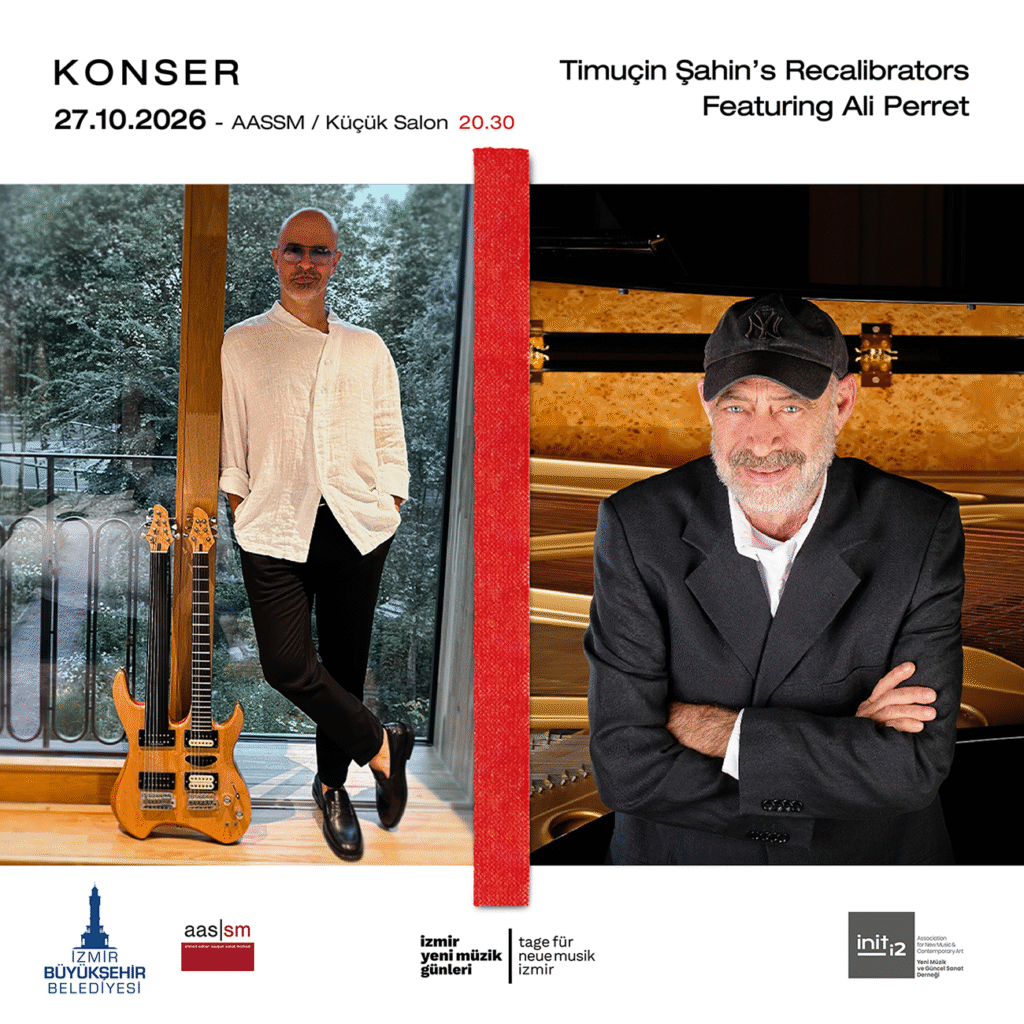
Timuçin Şahin’s Recalibrators featuring Ali Perret
27.10.2026-19.00 Ahmed Adnan Saygun Sanat Merkezi-Küçük Salon
Recalibrators is a conduction ensemble led by guitarist and composer Timuçin Şahin, drawing on the legacy of Lawrence “Butch” Morris and the practice of real-time collective composition.
Through open structures and instantaneous musical decisions, the ensemble moves between composition and improvisation, shaping the music collectively as it unfolds. A chamber-music sensibility and the sense of flow rooted in African American musical traditions are two fundamental elements of the ensemble’s musical language.
For this performance at İzmir New Music Days, Recalibrators is joined by pianist and composer Ali Perret, whose approach to composition and improvisation adds another dimension to the ensemble’s constantly evolving sound world.
IN ADDITION: